

Low Rates.
Our rates are low, our application is quick and easy! We can get you clear to close in as little as 10 days!
Trusted By Agents With








Meet Bill Rapp
NMLS ID # NMLS # 228246
Bill Rapp, CCIM is a Houston-based Capital Advisor at Medallion Funds, specializing in commercial real estate finance and strategic lending solutions. With over two decades of experience across brokerage and capital markets, Bill has worked with leading firms including eXp Commercial, NEXA Mortgage, Viking Enterprise LLC, and Sun Realty Houston.
A graduate of Texas A&M University with a BBA in Finance, Bill brings a disciplined, underwriting-first approach to every deal. His expertise spans commercial and residential financing, including asset-based lending, FHA financing, reverse mortgages, REO properties, and investment strategies for both single-family and commercial assets.
Known for his focus on structure over rate, Bill helps investors, business owners, and developers navigate complex transactions with clarity, precision, and a long-term wealth-building mindset.


The Client Experience
Great experience purchasing our first home! Bill was easy to reach and always able to answer any questions or concerns.


Loan Programs Available





Blogs
The Top 5 Mortgage Mistakes to Avoid

Buying your first home can be both exciting and nerve-wracking at the same time. With so many things to consider and....
Mortgage Do and
Do not list

Mortgages can be tricky, and it's easy to make mistakes that can end up costing you dearly. That's why we've put together this list....
Tips On How To Improve Your Credit Score

Let's talk about some ways you can improve your credit score! Your credit score is actually a big deal, and it can affect...
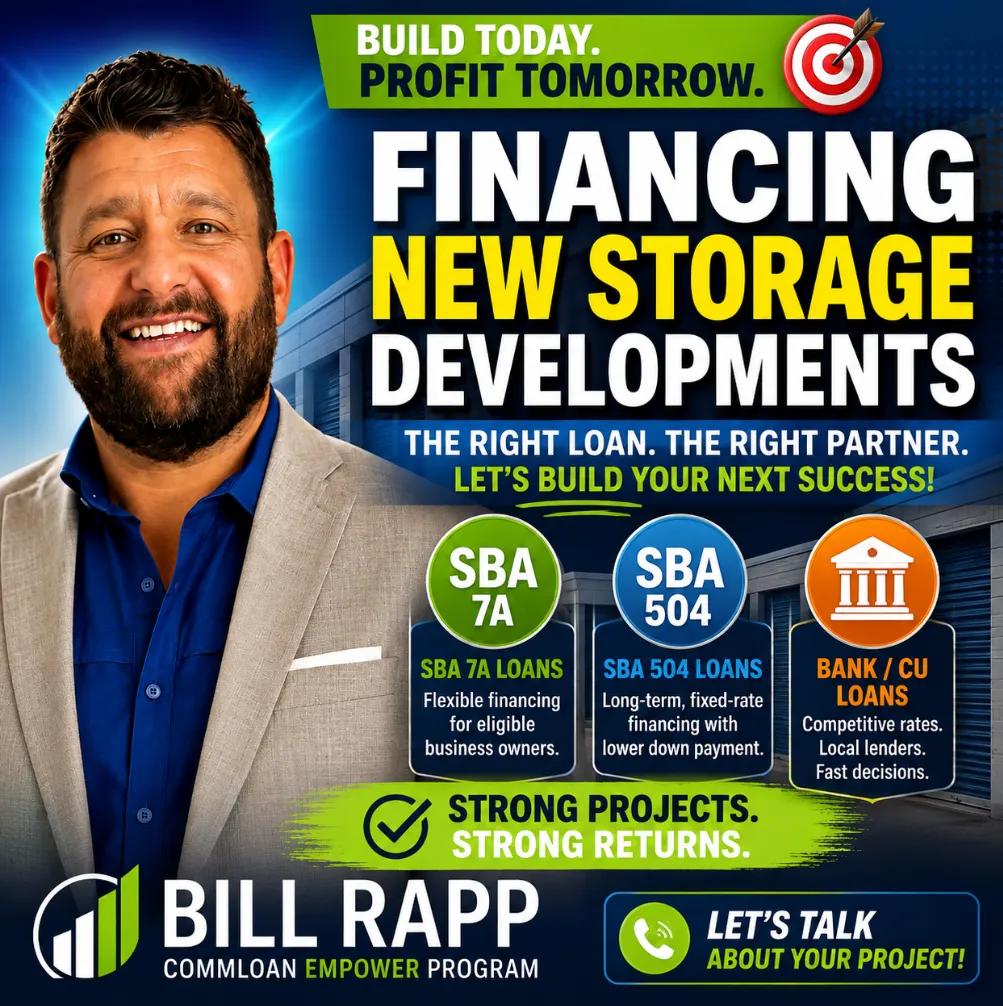
🏗️ Financing New Self-Storage Developments: SBA 7(a), SBA 504 & Bank Loan Options 🔑
🏗️ Financing New Self-Storage Developments: SBA 7(a), SBA 504 & Bank Loan Options 🔑
💰 Building a Self-Storage Facility? How to Finance New Construction with SBA & Bank Loans 🚧
Financing New Storage Developments: SBA 7(a), SBA 504, and Bank/Credit Union Loans
Developing a new self-storage facility can be an attractive commercial real estate opportunity, but getting from raw land to a stabilized property requires more than finding the right site.
You also need the right financing structure.
Unlike purchasing an existing stabilized self-storage property, ground-up development introduces construction risk, lease-up risk, cost overruns, and a period when the property may generate little or no operating income. That means lenders typically evaluate both the real estate and the underlying business plan.
For qualified projects, SBA 7(a) loans, SBA 504 loans, and conventional bank or credit union construction loans can all be potential financing solutions.
The important question isn't simply:
"Which lender has the lowest rate?"
It's:
"Which financing structure best fits the project, borrower, construction plan, and long-term business strategy?"
Let's look at the major options.
Why Financing a New Self-Storage Development Is Different
A stabilized self-storage facility already has an operating history. A lender can review occupancy, rental income, expenses, net operating income, and debt-service coverage.
A new development doesn't have that history.
Instead, lenders may need to underwrite projections involving:
·Land acquisition and existing land equity
·Construction costs
·Site work and infrastructure
·Soft costs
·Contingency reserves
·Interest carry
·Market feasibility
·Projected rental rates
·Lease-up assumptions
·Stabilized occupancy
·Sponsor liquidity
·Borrower experience
·Guarantor strength
·Exit or permanent financing strategy
The lender is effectively underwriting what the property should become, not simply what it produces today.
That's why preparing a strong development package can be just as important as choosing the loan program.
Option #1: SBA 7(a) Financing for Self-Storage Development
An SBA 7(a) loan can potentially finance eligible owner-operated self-storage businesses when the transaction and borrower satisfy SBA eligibility requirements.
One of the biggest attractions of SBA 7(a) financing is flexibility.
Depending on the transaction and current SBA requirements, eligible proceeds may potentially address multiple project costs within a single financing structure, including real estate acquisition, construction and other qualifying business expenses.
That can make the program particularly interesting when the project isn't simply a real estate development but an operating business requiring several categories of capital.
When SBA 7(a) May Make Sense
An SBA 7(a) structure may be worth evaluating when the borrower intends to operate the storage business and wants financing that can potentially combine several eligible project expenses.
The underwriting will still matter tremendously.
Expect the lender to scrutinize the development budget, projections, feasibility, borrower injection, liquidity, experience, global cash flow, credit profile and repayment strategy.
Important distinction: SBA financing isn't designed as passive investment-property financing. Eligibility and occupancy/operating requirements matter, and a self-storage project must be structured to comply with the applicable SBA rules.
Option #2: SBA 504 Loans for New Self-Storage Construction
The SBA 504 program is another potential solution for qualifying owner-operated self-storage developments involving fixed assets.
A typical SBA 504 transaction combines financing from a conventional lender with financing supported through a Certified Development Company, plus borrower equity.
For eligible projects, this structure can be attractive because it is designed around long-term fixed assets such as commercial real estate and major equipment.
Why Consider SBA 504?
For the right borrower and project, potential advantages can include:
Lower equity requirements. Preserving capital can be extremely important during construction and lease-up.
Long-term financing. A development should ideally have financing aligned with the economic life of the asset.
Fixed-rate component. The SBA-backed 504 portion can provide long-term fixed-rate financing.
Capital preservation. Keeping additional liquidity available can provide a valuable cushion against construction surprises and slower-than-projected lease-up.
But SBA 504 financing also comes with eligibility requirements and additional transaction mechanics. New businesses and certain special-purpose properties may also require greater borrower contribution.
The capital stack needs to be modeled for the specific transaction rather than assuming a standard structure will apply.
Option #3: Conventional Bank and Credit Union Construction Loans
For experienced developers with strong liquidity and sufficient equity, a conventional bank or credit union construction loan may be the most straightforward solution.
Banks and credit unions can have considerable discretion in how they underwrite these transactions.
A conventional lender may evaluate:
·Loan-to-cost
·Loan-to-value
·Borrower equity
·Guarantor liquidity
·Net worth
·Development experience
·Market feasibility
·Construction budget
·General contractor experience
·Projected stabilization
·Debt-service coverage
·Recourse
·Interest reserves
·Construction timeline
One lender might love self-storage development in a particular market while another has reached its internal concentration limit and won't consider another storage loan.
That is why lender selection matters.
A strong project presented to the wrong lender can still produce a rejection.
SBA vs. Conventional Financing: What's the Better Choice?
There isn't a universal winner.
An SBA loan might offer a compelling capital structure for an eligible owner-operated project, particularly when conserving borrower capital is important.
A conventional bank or credit union loan may provide greater flexibility for an experienced developer with substantial equity and a strong banking relationship.
The decision should be based on the entire capital structure, not just the interest rate.
Consider:
Equity requirement: How much cash must you contribute?
Interest rate: Is it fixed or floating?
Amortization: How quickly will principal be repaid?
Construction period: How are draws handled?
Interest carry: Is interest during construction included?
Recourse: What guarantees are required?
Fees: What are the total financing costs?
Prepayment: What restrictions or penalties apply?
Permanent financing: Does the construction loan convert, or will you need to refinance after stabilization?
Those variables can materially change the economics of the development.
What Lenders Want to See in a Self-Storage Development
One of the best ways to improve the financing process is to approach lenders with a complete and financeable story.
That normally starts with the site and development plan.
Where is the property? What is the surrounding population? What are household growth trends? How much competing storage inventory already exists? What's currently under construction?
Then comes the financial model.
What is the total development cost? How much equity is being invested? How quickly is occupancy projected to grow? What rental rates support the projections? When does the property reach break-even and stabilization?
Finally, lenders need to understand the sponsor.
Does the borrower have development, construction, commercial real estate, or self-storage operating experience? What liquidity remains after closing? What does the guarantor's financial position look like if lease-up takes longer than anticipated?
The stronger those answers are, the easier it becomes to identify lenders whose underwriting criteria match the transaction.
Don't Finance the Project in a Vacuum
One of the biggest financing mistakes developers can make is choosing debt based primarily on the advertised rate.
Imagine one loan offers a slightly lower rate but requires substantially more equity.
Another provides more leverage but carries a higher rate.
A third offers attractive construction financing but creates refinancing risk immediately after completion.
Which one is best?
You can't answer that from the interest rate alone.
You need to understand the project's capital requirements, construction timeline, lease-up period, stabilization strategy, cash flow, and long-term ownership plan.
The financing should support the business plan—not force the business plan to accommodate the financing.
Start the Financing Conversation Early
Developers shouldn't wait until construction is ready to begin before talking to lenders.
Starting earlier gives you an opportunity to determine whether the project's assumptions are financeable before committing significant capital.
That can help identify issues involving equity, liquidity, construction costs, feasibility, borrower experience, guarantor requirements, or projected debt coverage while there is still time to address them.
It also allows you to compare SBA 7(a), SBA 504, bank, and credit union financing options rather than being forced into whichever lender can meet an approaching deadline.
How CommLoan Can Help
At CommLoan, commercial real estate borrowers can evaluate financing opportunities across a broad lending marketplace rather than relying exclusively on a single institution.
For a new self-storage development, that can be particularly valuable because lender appetite varies considerably.
The objective isn't simply to find a loan.
It's to identify a financing structure that aligns the construction budget, required equity, debt service, lease-up period, and long-term strategy.
If you're planning a new self-storage development, consider evaluating your financing alternatives before you finalize the capital stack.
Top of Form
Bottom of Form
Bill Rapp, CCIM
Director | CommLoan
📞 281-222-0433
📧 [email protected]
🌐 https://billrapp.commloan.com/
🌐 https://HoustonCommercialMortgage.com/
Commercial Real Estate Financing Nationwide
https://billrapp.commloan.com/
https://author.billrapponline.com/
https://www.amazon.com/dp/B0F32Z5BH2
https://veed.cello.so/FOmzTty6oi9
https://buymeacoffee.com/vikingente3
https://creplaybookseries.billrapponline.com
https://creplaybook.billrapponline.com/
©Bill Rapp, CCIM - Director - CommLoan

10 Tips for First-Time Homebuyers

Buying your first home can be both exciting and nerve-wracking at the same time. With so many things to consider and....
How To Choose the Right Lender for You

Lorem Ipsum is simply dummy text of the printing and typesetting industry. Lorem Ipsum has been the industry's standard dummy
Refinancing youe loan and when to do it

Lorem Ipsum is simply dummy text of the printing and typesetting industry. Lorem Ipsum has been the industry's standard dummy

Copyright ©2021 | Mortgage Viking Team
Licensed to Do Business | NMLS # 228246
This is not an offer to enter into an agreement. Not all customers will qualify. Information, rates and programs are subject to change without notice. All products are subject to credit and property approval. Other restrictions and limitations may apply. Copyright © 2021 | Medallion Funds
Corporate | NMLS ID NMLS # 1825831
Corporate Address : 2651 N. Green Valley Pkwy STE. 101 Henderson, NV 89014
Corporate NMLS NMLS # 1825831 | Company Website: https://medallionfunds.com/bill-rapp/
Copyright ©2021 | Mortgage Viking Team Licensed to Do Business | NMLS # 228246
This is not an offer to enter into an agreement. Not all customers will qualify. Information, rates and programs are subject to change without notice. All products are subject to credit and property approval. Other restrictions and limitations may apply
Corporate | NMLS ID NMLS # 1825831
Corporate Address : 2651 N. Green Valley Pkwy STE. 101 Henderson, NV 89014 https://medallionfunds.com/bill-rapp/
Facebook
Instagram
X
LinkedIn
Youtube
TikTok