

Low Rates.
Our rates are low, our application is quick and easy! We can get you clear to close in as little as 10 days!
Trusted By Agents With








Meet Bill Rapp
NMLS ID # NMLS # 228246
Bill Rapp, CCIM is a Houston-based Capital Advisor at Medallion Funds, specializing in commercial real estate finance and strategic lending solutions. With over two decades of experience across brokerage and capital markets, Bill has worked with leading firms including eXp Commercial, NEXA Mortgage, Viking Enterprise LLC, and Sun Realty Houston.
A graduate of Texas A&M University with a BBA in Finance, Bill brings a disciplined, underwriting-first approach to every deal. His expertise spans commercial and residential financing, including asset-based lending, FHA financing, reverse mortgages, REO properties, and investment strategies for both single-family and commercial assets.
Known for his focus on structure over rate, Bill helps investors, business owners, and developers navigate complex transactions with clarity, precision, and a long-term wealth-building mindset.


The Client Experience
Great experience purchasing our first home! Bill was easy to reach and always able to answer any questions or concerns.


Loan Programs Available





Blogs
The Top 5 Mortgage Mistakes to Avoid

Buying your first home can be both exciting and nerve-wracking at the same time. With so many things to consider and....
Mortgage Do and
Do not list

Mortgages can be tricky, and it's easy to make mistakes that can end up costing you dearly. That's why we've put together this list....
Tips On How To Improve Your Credit Score

Let's talk about some ways you can improve your credit score! Your credit score is actually a big deal, and it can affect...
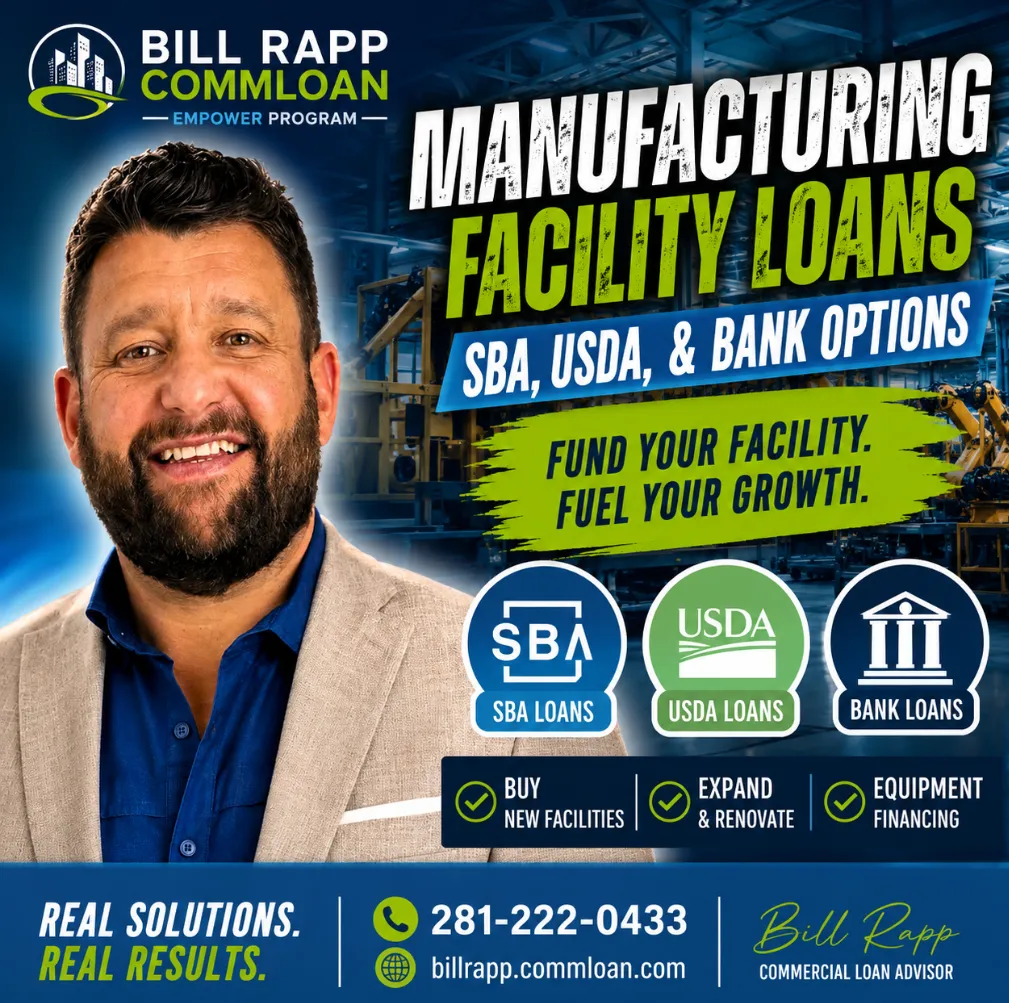
🏭 Manufacturing Facility Loans: How SBA, USDA & Bank Financing Can Fund Your Next Expansion 🚀
🏭 Manufacturing Facility Loans: How SBA, USDA & Bank Financing Can Fund Your Next Expansion 🚀
💰 Financing a Manufacturing Facility? Compare SBA, USDA & Traditional Bank Loan Options 🏗️
Manufacturing Facility Loans: SBA, USDA, and Bank Options
Financing a manufacturing facility is rarely as simple as finding the lender offering the lowest interest rate. Manufacturers often have complex capital requirements involving commercial real estate, specialized equipment, construction, renovations, working capital, and business expansion—sometimes within the same transaction.
That makes loan structure particularly important.
For manufacturers looking to purchase, build, refinance, renovate, or expand an industrial facility, three financing channels should frequently be considered: SBA loans, USDA business loans, and conventional bank financing.
Each serves a different purpose, and understanding those differences can help business owners identify a financing structure that supports both the real estate transaction and the long-term operating needs of the company.
Why Manufacturing Facility Financing Is Different
A manufacturing property isn't simply another industrial building.
The real estate may include specialized electrical capacity, heavy power, cranes, production lines, ventilation systems, loading infrastructure, wastewater systems, cold storage, clean rooms, specialized plumbing, or other improvements designed specifically around the operating company.
A financing package may therefore need to cover more than the building itself.
Depending on the transaction, financing could involve:
·Acquisition of an existing manufacturing facility
·Ground-up construction
·Building renovations and improvements
·Expansion of an existing facility
·Machinery and equipment
·Refinancing existing commercial debt
·Business acquisition costs
·Working capital associated with an expansion
The right loan program depends on the business, property, project cost, location, cash flow, ownership structure, collateral, and long-term business plan.
Option 1: SBA Loans for Manufacturing Facilities
For qualifying owner-occupied manufacturing businesses, SBA financing can be one of the most powerful options available.
Two programs are particularly relevant: SBA 7(a) and SBA 504 financing.
SBA 7(a) Loans
SBA 7(a) financing offers considerable flexibility because eligible loan proceeds can potentially cover multiple components of a transaction.
Depending on the project and eligibility requirements, proceeds may be used toward real estate, equipment, improvements, business acquisition costs and certain other eligible business expenses.
That flexibility can be particularly useful when the financing need extends beyond simply purchasing a building.
Imagine a manufacturer purchasing a facility that also needs new production equipment and improvements before operations can begin. A financing structure capable of addressing several components of the project may be considerably more useful than a conventional commercial mortgage focused primarily on the real estate.
SBA 504 Loans
The SBA 504 program is designed primarily around major fixed assets such as owner-occupied commercial real estate and long-term equipment.
For manufacturers making substantial investments in facilities and machinery, 504 financing deserves serious consideration.
Its structure can potentially provide attractive long-term financing while allowing the business to preserve more working capital than might be required under a conventional commercial real estate loan.
SBA financing can be especially compelling when a manufacturer wants to own its facility rather than continue leasing.
Option 2: USDA Financing for Manufacturing Facilities
Manufacturers located in eligible rural communities may have another financing tool available: USDA-backed business financing.
The word "rural" can cause business owners to dismiss USDA programs prematurely.
That can be a mistake.
USDA eligibility extends well beyond farms and agricultural businesses. Depending on the specific program, property location, project and borrower qualifications, manufacturing and industrial businesses in eligible areas may potentially benefit from USDA-supported financing.
For companies evaluating facilities outside major urban centers, USDA eligibility should therefore be investigated early in the site-selection and financing process.
Why USDA Financing Can Matter
Manufacturing projects can be capital intensive. A company may need to finance land, buildings, equipment, improvements, infrastructure and expansion costs.
USDA-backed financing can potentially help lenders support qualifying projects that contribute to economic activity and employment in eligible communities.
This makes USDA financing particularly relevant to manufacturers considering rural or secondary-market locations where land costs, workforce availability and access to transportation infrastructure may already create compelling operational advantages.
Location can therefore influence more than the price of the property—it can influence the financing options available to the business.
Option 3: Conventional Bank Loans
Traditional banks and credit unions remain an important source of manufacturing facility loans.
For established businesses with strong financial statements, sufficient liquidity, solid collateral and predictable cash flow, conventional financing may provide a relatively straightforward solution.
Banks can offer financing for acquisitions, refinances, construction, equipment and other business purposes, although loan structures and underwriting requirements vary significantly from institution to institution.
That last point matters.
One bank declining a manufacturing loan does not necessarily mean the transaction is unfinanceable.
Banks have different concentrations, geographic preferences, collateral requirements, loan-size preferences, industry appetites and underwriting guidelines. A manufacturing project that falls outside one bank's credit box may fit another lender extremely well.
SBA vs. USDA vs. Bank Financing
There isn't a universally "best" manufacturing facility loan.
The objective is to match the financing structure to the business plan.
SBA financing may be particularly attractive for qualifying owner-users seeking higher leverage or financing involving multiple business assets and project costs.
USDA financing may deserve consideration when the manufacturing operation is located in an eligible market and the project meets applicable program requirements.
Conventional bank financing can be highly competitive for financially strong borrowers who can meet a bank's equity, collateral and debt-service requirements.
The comparison should extend beyond interest rate.
Business owners should also evaluate:
·Required equity
·Amortization
·Loan maturity
·Fixed versus variable pricing
·Prepayment provisions
·Collateral requirements
·Personal guarantees
·Equipment financing
·Construction financing
·Working-capital needs
·Closing timeline
·Documentation requirements
A slightly lower rate can become far less attractive if the loan requires substantially more equity, has a shorter amortization period, or doesn't finance critical portions of the project.
Don't Separate the Real Estate From the Business Plan
One of the biggest mistakes in manufacturing financing is evaluating the property loan in isolation.
Suppose a company has $2 million available for an expansion.
If the lender requires nearly all of that capital as equity toward the building acquisition, what happens when the manufacturer still needs machinery, inventory, hiring, facility improvements and operating reserves?
The building might be adequately financed while the business becomes undercapitalized.
That's why manufacturing facility financing should begin with the complete capital stack.
Determine what the business needs for the real estate, equipment, improvements, reserves and future operations before deciding how much cash should be invested into the property.
Financing Ground-Up Manufacturing Construction
New manufacturing facilities introduce another level of complexity.
A lender may need to evaluate:
·Land acquisition
·Construction budget
·Plans and specifications
·Contractor experience
·Construction timeline
·Equipment installation
·Utility requirements
·Environmental considerations
·Borrower equity
·Stabilized business cash flow
·Project completion risk
The financing strategy should ideally be evaluated before major commitments are made to land, design, construction contracts or equipment purchases.
Early financing analysis can help determine whether the proposed project aligns with realistic lender requirements.
Financing Manufacturing Equipment
Manufacturing equipment can represent a substantial percentage of total project cost.
CNC machinery, production lines, fabrication equipment, robotics, packaging systems, refrigeration, specialized electrical systems and other machinery can require significant capital.
Equipment should therefore be considered alongside the commercial real estate financing—not after the building loan has already consumed the company's available liquidity.
Depending on the situation, equipment may be financed within a broader transaction or through a separate equipment facility.
The appropriate structure depends on useful life, collateral value, project timing and the overall capital requirements of the company.
The Most Important Question Isn't "What's the Rate?"
Manufacturers naturally want competitive interest rates.
But the better opening question is:
What financing structure best supports the business plan?
A loan with excellent pricing but insufficient proceeds may not solve the problem.
Neither will a loan requiring so much equity that the company lacks the capital necessary to operate and expand.
The strongest manufacturing financing structure balances cost of capital, leverage, cash flow, liquidity, flexibility and execution certainty.
Compare Manufacturing Facility Loan Options Before You Commit
Manufacturing loans are highly dependent on the borrower, property, industry, project and lender.
Instead of approaching a single institution and assuming its answer represents the entire market, business owners can benefit from comparing multiple financing strategies.
Through the Bill Rapp – CommLoan Empower Program, manufacturing businesses and commercial real estate investors can evaluate financing opportunities across a broad commercial lending marketplace.
Whether you're purchasing an existing facility, constructing a new manufacturing plant, expanding your current operation, refinancing commercial debt, or evaluating equipment and real estate financing together, the objective should remain the same:
Match the financing to the business plan—not the business plan to the financing.
Ready to Explore Manufacturing Facility Financing?
If you're considering purchasing, building, refinancing, or expanding a manufacturing facility, evaluate the financing structure early in the process.
Comparing SBA, USDA, conventional bank, and other commercial financing options can help identify the structure that best supports your property, your operations and your long-term growth strategy.
Top of Form
Bottom of Form
Bill Rapp, CCIM
Director | CommLoan
📞 281-222-0433
📧 [email protected]
🌐 https://billrapp.commloan.com/
🌐 https://HoustonCommercialMortgage.com/
Commercial Real Estate Financing Nationwide
https://billrapp.commloan.com/
https://author.billrapponline.com/
https://www.amazon.com/dp/B0F32Z5BH2
https://veed.cello.so/FOmzTty6oi9
https://buymeacoffee.com/vikingente3
https://creplaybookseries.billrapponline.com
https://creplaybook.billrapponline.com/
©Bill Rapp, CCIM - Director - CommLoan

10 Tips for First-Time Homebuyers

Buying your first home can be both exciting and nerve-wracking at the same time. With so many things to consider and....
How To Choose the Right Lender for You

Lorem Ipsum is simply dummy text of the printing and typesetting industry. Lorem Ipsum has been the industry's standard dummy
Refinancing youe loan and when to do it

Lorem Ipsum is simply dummy text of the printing and typesetting industry. Lorem Ipsum has been the industry's standard dummy

Copyright ©2021 | Mortgage Viking Team
Licensed to Do Business | NMLS # 228246
This is not an offer to enter into an agreement. Not all customers will qualify. Information, rates and programs are subject to change without notice. All products are subject to credit and property approval. Other restrictions and limitations may apply. Copyright © 2021 | Medallion Funds
Corporate | NMLS ID NMLS # 1825831
Corporate Address : 2651 N. Green Valley Pkwy STE. 101 Henderson, NV 89014
Corporate NMLS NMLS # 1825831 | Company Website: https://medallionfunds.com/bill-rapp/
Copyright ©2021 | Mortgage Viking Team Licensed to Do Business | NMLS # 228246
This is not an offer to enter into an agreement. Not all customers will qualify. Information, rates and programs are subject to change without notice. All products are subject to credit and property approval. Other restrictions and limitations may apply
Corporate | NMLS ID NMLS # 1825831
Corporate Address : 2651 N. Green Valley Pkwy STE. 101 Henderson, NV 89014 https://medallionfunds.com/bill-rapp/
Facebook
Instagram
X
LinkedIn
Youtube
TikTok